Using GPR to Find UXOs

Contact sales

Get in touch with us for expert help.

Using GPR to Find and Mitigate the Risk of UXOs

Finding and mitigating the risks of UXO, IEDs, and other subsurface hazards using GPR – ideally as part of a multi-sensor detection strategy – is essential for restoring safety to post-conflict regions. Although active fighting may have ended, the lethal threat often persists for decades. Today, the global risk from Unexploded Ordnance (UXO), Unexploded Bombs (UXB), and landmines remains critically high, making advanced geophysical methods vital for reclaiming land and restoring safety to these communities.

Potentiel IEDs half-buried in sand

These Explosive Remnants of War (ERW) represent a systemic threat to human life, infrastructure projects, and the environment. To facilitate safe land development and reconstruction, professional UXO clearance is essential. This multi-stage process involves the detection, mapping, and safe disposal of ordnance ranging from metallic shells to low-metal content plastic mines and this is where Ground Penetrating Radar (GPR) can be a valuable component.

The Multi-Sensor Strategy for Finding UXOs

Due to the vast diversity in target size, material, and burial depth, a single detection method is never sufficient. A robust risk mitigation plan should follow the ALARP (As Low As Reasonably Practicable) principle, utilizing a multi-sensor approach:

An infographic showing how Finding and mitigating the risk of UXO using GPR with a Multi-sensory approach works
  • Satellite & Aerial Imagery: For initial site assessment.
  • Magnetometer Surveys: Highly effective for ferrous (magnetic) objects.
  • EMI (Electromagnetic Induction): Standard for metal detection.
  • GPR (Ground Penetrating Radar): Critical for detecting non-metallic (plastic) threats and providing 3D spatial context.
  • UWB SAR & LiDAR: For wide-area reconnaissance and surface mapping.
  • Note: A mechanical approach can also be applied.  

The Role of GPR in UXO Detection

GPR is a premier non-destructive method for subsurface imaging. By transmitting electromagnetic waves and recording reflections, GPR identifies dielectric contrasts between an object and the surrounding soil. A buried UXO typically manifests in the data as a characteristic hyperbola.

Frequency, Resolution, and Depth for finding UXOs with Radar

When selecting a ground penetrating radar system from Guideline Geo, the choice of antenna frequency is paramount. It defines the balance between how deep you can see and how small an object you can resolve:

  • Higher Frequencies (up to 2300 MHz): Exceptional resolution for small targets like anti-personnel mines at shallow depths.
  • Lower Frequencies (around 450 MHz): Better penetration for larger aerial bombs (UXBs) buried deep in the subsurface.


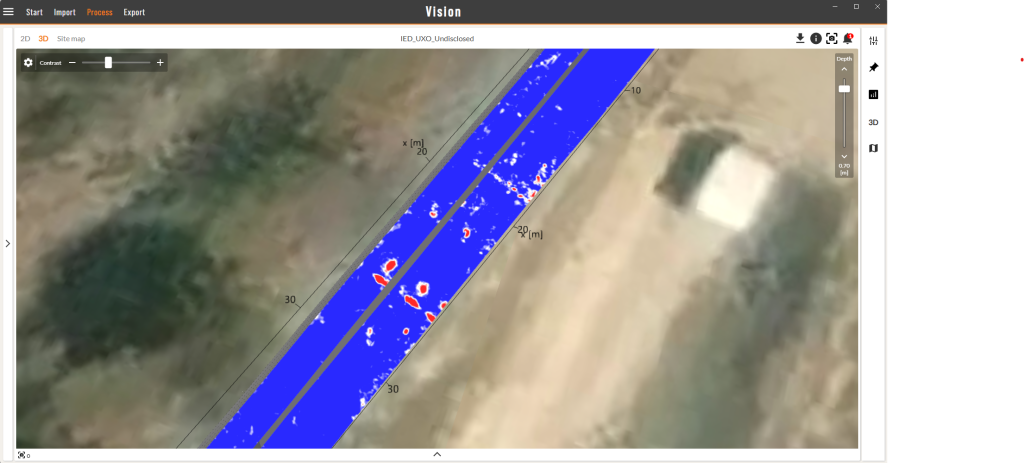
A GPR depth slice collected with a MALÅ MIRA ground penetrating radar at an undisclosed military site. Red color indicates areas of interest and potential buried IED's.
MIRA data collected along a dirt road at an undisclosed military site. Image shows depth slice at 0.7 m. Red color indicates areas of interest and potential buried IED's.  

Critical Limitations for using GPR when searching for UXOs:

Potential IEDs which after investigation were found out to be nothing more dangerous than old skateboard wheels
When using GPR, discrimination becomes a problem. Objects of similar size will often give similar subsurface response. For UXO/IED detection, a multi-disciplinary approach is recommended.  
  • While GPR is a powerful tool, it cannot guarantee 100% detection, and signal interpretation can be complicated by clutter (e.g., stones, roots or other mundane items) that mimic UXO signatures.
  • Mapping smaller UXO´s at larger depths also poses a challenge, as the resolution of a GPR decreases with depth. 

Advanced GPR Methodologies

2D Versus 3D-Ground Penetrating Radar

While single 2D profiles are useful for quick reconnaissance, modern safety standards often require 3D GPR data volumes. By collecting dense data, we can generate depth slices – horizontal maps of the ground at specific intervals. This allows operators to visualize the shape, orientation, and exact depth of a target, significantly reducing false positives.

A selection of MALÅ GroundExplorer HDR antennas designed for varying subsurface investigation depths.
MALÅ Ground Explorer (GX): A Single-Channel 2D GPR available in many different frequencies

Profiles must be spaced closely with a single-channel 2D GPR (e.g., 25 cm spacing for a 50 cm target) to ensure the radar beam crosses the object.

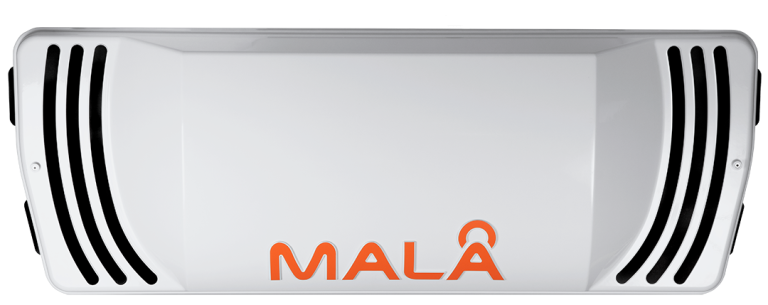
The MALÅ MIRA HDR array GPR (Ground Penetrating radar)
MALÅ MIRA HDR: A Multi-Channel 3D GPR

Multi-Channel 3D GPR-systems like the MALÅ MIRA Compact, MALÅ MIRA Flex or MALÅ MIRA HDR offer a fixed 6.5 cm profile spacing. This provides a gapless data web, ensuring even the smallest threats are captured in high resolution.

Drone-Based GPR: Safety vs. Resolution

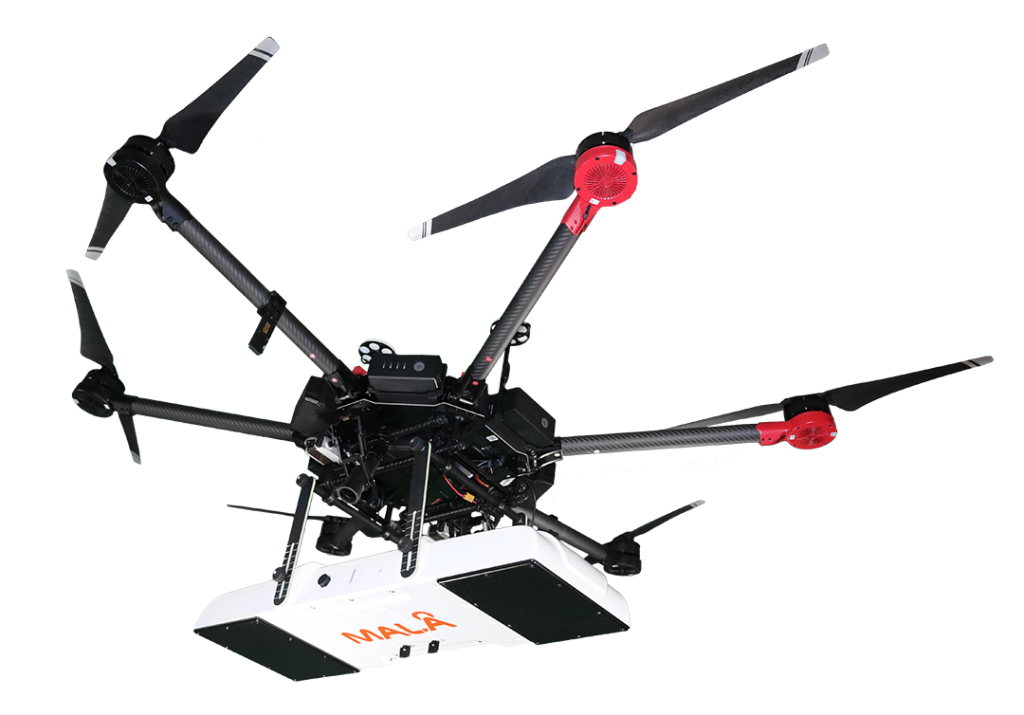
The MALÅ GeoDrone 600 GPR (Ground Penetrating Radar).

In “high-threat” areas where ground access is too dangerous, drone-based GPR (such as the MALÅ GeoDrone 600) is an invaluable reconnaissance tool. However, users must account for the air gap (which increases the footprint) between the drone and the ground, which can dissipate signal energy and reduce the ability to detect very small items like landmines. Drone solutions are best suited for larger targets or as a primary tool to identify high-interest zones for further investigation.


Guideline Geo: Industry-Leading Solutions

We provide the full spectrum of GPR technology required for professional UXO risk mitigation:

Want to know more about Using GPR to Find UXOs?

Or find a office near you

Newsletter

Sign up for Guideline Geo’s newsletter and be the first to know.